
Contents
Quick answer: choose a Flygt N-pump guide-rail (P) installation when a permanent wet well needs repeatable pump retrieval and an automatic discharge connection. Choose a free-standing (S) arrangement when the duty is transportable or a fixed guide system is impractical, and specify the hose or pipe connection and stable support separately. The pump model alone does not define the installation package. Confirm the exact pump configuration, discharge interface, lifting method, cable route, wet-well geometry and operating duty before ordering.
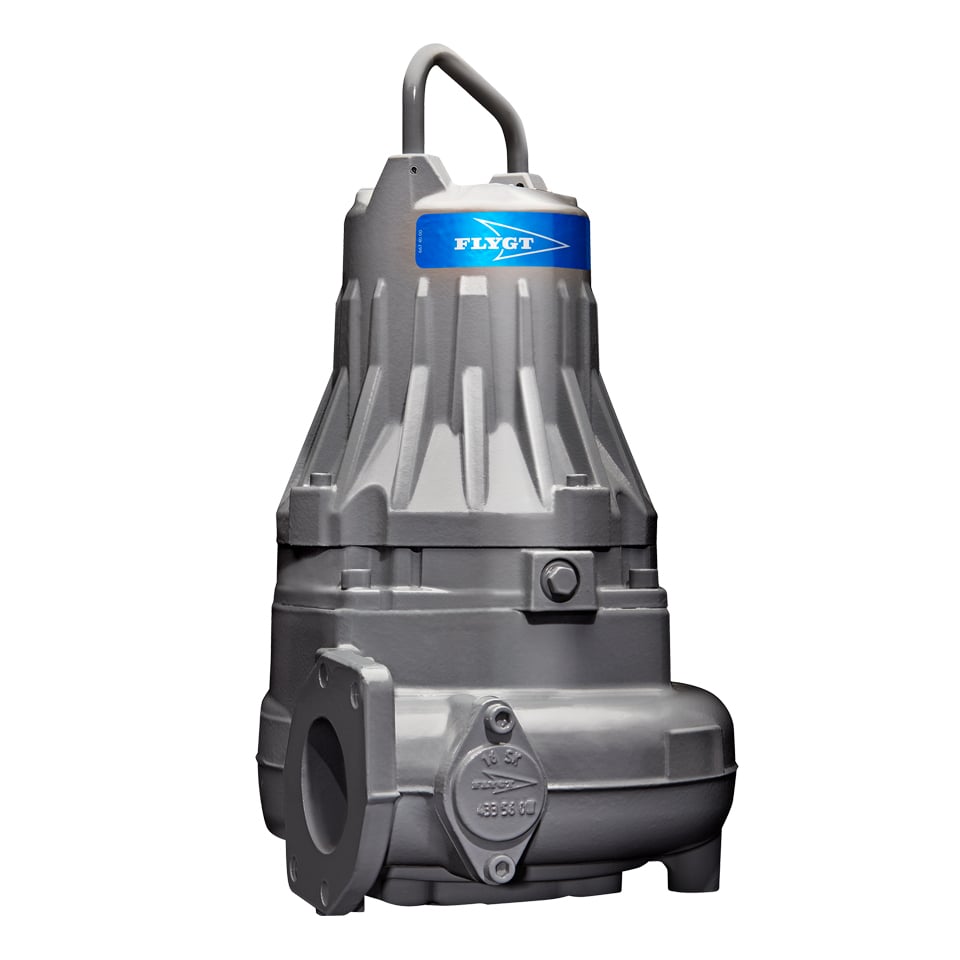
In Xylem’s N-pump installation terminology, P uses twin guide bars and a discharge connection in a wet well; S is a semi-permanent free-standing arrangement with a pipe or hose connection. This guide explains the purchasing and maintenance decisions behind those labels. The featured Flygt pump photograph is a product-family reference; it does not show a complete guide-rail or free-standing installation kit.
What changes between P and S installation?
Both arrangements can place a suitable submersible N-pump in a wet environment, but the mechanical interface and retrieval workflow differ. In a P installation, the pump is lowered along guide bars to mate with a fixed discharge connection. The pipework can remain in place when the pump is raised for inspection, provided the complete guide system is correctly designed and installed. In an S installation, the pump stands on its own support and connects to a suitable discharge hose or pipe. Removal may require disconnecting or handling that connection according to the site design.
Do not read P or S as a promise that every N-pump model is available in every configuration. Xylem’s model-specific documentation and the exact product number govern what can be supplied. The hydraulic curve, motor, cable and material selection still have to match the liquid and system duty.
Swipe the table horizontally to view all columns.
| Decision point | Guide-rail P installation | Free-standing S installation |
|---|---|---|
| Typical use | Repeated service in a fixed wet-well station | Temporary, movable or semi-permanent duty where the connection can be handled |
| Discharge interface | Fixed base/discharge connection matched to the pump | Compatible hose or pipe connection with suitable support |
| Retrieval | Lift pump along guide bars; inspect the mating face and lifting gear | Lift after making the discharge connection safe and following the site procedure |
| Procurement risk | Wrong base, guide dimensions or coupling can prevent seating | Wrong outlet, hose rating or support can make the package unusable |
| Documents to check | Exact pump and base drawings, rail geometry, lifting plan | Exact outlet drawing, support, hose/pipe and lifting plan |
Choose the arrangement from the station, not just the pump
Access and maintenance frequency
In a deep or confined wet well, operators may need to retrieve the pump repeatedly without entering the pit. A correctly specified guide system can make that workflow more practical: the pump travels on the rails to a fixed discharge connection. Plan safe lifting points, the chain or approved lifting device, cable support and clear access above the hatch. The site lifting procedure and current manufacturer manual remain essential.
For a portable bypass, construction dewatering or short-term transfer, the ability to relocate a free-standing pump may matter more than a permanent base. Verify that the selected N-pump and its installation kit are suitable for that duty; a convenient hose connection does not remove the need for correct head, flow, solids handling and electrical protection.
Wet-well geometry and pipework
A P package needs space and alignment for the discharge base, guide bars, upper brackets and lifting path. Existing civil works can constrain rail spacing, pump orientation and hatch clearance. An S package needs a firm, level support position and a hose or pipe route that does not pull the pump over or load its outlet. In both cases, check inlet hydraulics, minimum submergence, sediment and rag accumulation, operating water levels and access for cleaning.
Neither installation label resolves an undersized force main or a poor duty point. Use the system curve and the selected pump curve, including the actual discharge connection losses. For a model shortlist, see DFIN’s Flygt N-pump selection guide.
How to avoid a wrong guide-rail replacement
A replacement pump can have the right nominal discharge size and still fail to mate with the installed base. Before asking for a like-for-like P unit, record the complete nameplate and product number, serial number, frequency, voltage, impeller details and installation code. Photograph the pump’s mating interface and the installed discharge connection after safe isolation. Obtain drawings or measure the rail size and spacing, base bolt pattern, outlet position, guide bracket and available lifting clearance where documentation is missing.
Keep the existing lifting chain and cable routing in the scope review. A cable is not a lifting device. Check wear or damage on the guide system and mating surfaces; an apparent pump fault can be a poor seating or damaged connection. If the old pump clogged or wore rapidly, investigate the liquid and duty rather than automatically reproducing the same hydraulic configuration. DFIN’s Flygt N-pump low-flow guide helps separate hydraulic or system faults from the installation interface.
What to specify for a free-standing package
For an S arrangement, identify the exact outlet connection, hose or pipe size, pressure class, bend radius and compatible fittings. Confirm the pump’s support or stand, cable length, electrical connector or termination, and how the assembly will be secured against movement. A flexible hose needs a route that avoids kinks, abrasion and accidental loading. A rigid pipe may require independent support so that its weight or thermal movement is not imposed on the pump connection.
Decide who supplies the hose, check valve, isolation valve, lifting gear, level controls and control panel. These are scope items, not assumed parts of a bare pump. If the pump will move between sites, list each site’s voltage, frequency, discharge arrangement, liquid and duty point. The same pump cannot be assumed suitable for every location without reviewing those conditions.
Installation and commissioning checks
- Confirm identity: match the delivered pump, installation code and accessories against the purchase order and manufacturer drawings.
- Make the site safe: isolate electrical power and liquid hazards; use the approved lifting and confined-space procedures for the station.
- Inspect interfaces: for P, check base, guide bars, brackets and seating surfaces; for S, check support and the hose or pipe connection.
- Protect the cable: support it so it cannot be pinched, abraded or used to lift the pump.
- Verify hydraulics: check open valves, discharge path, level controls and the operating point against the selected curve.
- Record the first run: log flow or level drawdown, current, vibration or noise, leakage alarms and any unusual movement.
This is a procurement and inspection checklist, not a substitute for the exact Flygt installation, operation and maintenance manual or the site’s safety procedure. If the pump does not seat, leaks at the connection or trips on start, stop and investigate before forcing a restart.
RFQ checklist and price factors
Ask suppliers to quote the same scope. The price of a bare pump is not comparable with a package containing a discharge base, guide bars, brackets, chain, cable, hose, controls and installation work. Cost changes with the exact hydraulic and motor configuration, materials, sealing, cable length, accessory set, documentation, destination and required service scope. Request an itemized quotation rather than relying on a universal online price.
- Flow, total dynamic head and minimum/normal/peak wet-well levels.
- Liquid, solids and fibres, temperature, abrasives and any hazardous-area requirement.
- Full existing nameplate, product number, serial number and clear pump photographs.
- P or S installation intent; existing base, rails, outlet and station drawings.
- Discharge pipe or hose dimensions, connection standard, valve scope and force-main details.
- Voltage, phase, frequency, controls, cable length and lifting arrangement.
- Quantity, delivery country and exactly which accessories and services are included.
Review DFIN’s Flygt product-family range and send the RFQ with station drawings and photographs. DFIN can check the requested configuration and identify which interface details need confirmation before a quotation is finalized.
Frequently asked questions
Can a free-standing Flygt N-pump be converted to guide rails?
Possibly for some configurations, but never assume interchangeability. Verify the exact pump product number, compatible P installation kit, discharge base, rail geometry, motor and cable arrangement against current model-specific documentation. Civil and pipework changes may also be required.
Does the guide-rail base come with the pump?
That depends on the quoted package. List the discharge connection, guide bars, upper brackets, lifting gear and installation work as separate scope lines unless the supplier explicitly includes them.
Is a free-standing pump only for temporary work?
No. Xylem describes S as semi-permanent and transportable. Suitability depends on the exact pump, support, outlet connection, electrical design, duty and site maintenance plan.
What is the most important measurement for a replacement P pump?
No single dimension is enough. The complete product identity and the mating geometry of the existing discharge connection and guide system must agree. Send nameplates, drawings and photos together so the supplier can check the whole interface.