Contents
Short answer: If a WILDEN P100 cycles but does not prime or deliver liquid, first confirm that liquid can reach the inlet and that the suction line is airtight. Then reduce the cycle rate and check for a blocked inlet, excessive suction lift, discharge restriction or a check valve that cannot seat. Open the pump only after isolating and depressurizing the air and liquid systems. A working air motor does not prove that the liquid end is filling.
What does “cycles but no flow” tell you?
The repeating exhaust sound shows that the air distribution system is moving the diaphragms. It does not show that each liquid chamber fills and empties correctly. A P100 may pass mostly air when the suction source is empty, a hose admits air under vacuum, a strainer is obstructed or the inlet is too far above the liquid. A valve ball held off its seat can also let liquid move back and forth inside the pump instead of leaving the discharge.
Describe the symptom precisely before ordering parts. Does the pump never draw liquid, prime and then lose flow, or move a little liquid at a high cycle rate? Did the fault start after a hose change, a wet-end service or a change of fluid? Those distinctions point to different checks. If process liquid appears at the air exhaust, stop and investigate a possible diaphragm or seal failure rather than treating it as an ordinary priming issue.
Check the installation before opening the pump
- Confirm the liquid source. Verify actual tank level, the correct open isolation valves and that the suction pickup remains submerged. A closed valve or an empty container can look like a pump fault.
- Inspect the complete inlet path. Check the strainer, foot connection, hose and fittings for blockage, collapsed lining, loose clamps and chemical damage. Use a suction hose suitable for vacuum service; an ordinary soft hose may flatten while the pump runs.
- Look for air ingress. Inspect threaded joints, gaskets and the inlet manifold. A suction leak may admit air without leaking liquid outward, especially when the pump is lifting from below. Reseal the suspect connection to the approved installation procedure and retest.
- Review the suction arrangement. Compare the actual vertical lift, hose length, fluid viscosity and temperature with the correct P100 manual and installed configuration. Do not assume a catalog maximum is available in every liquid or installation. If safe and permitted, a short flooded-suction test can help separate installation loss from an internal pump fault.
- Check the outlet. Verify that the discharge path is open, the line is not blocked and the pressure is not preventing the pump from delivering. Record the pressure while running rather than relying on a regulator setting alone.
For chemical or hazardous service, follow the site isolation, containment and protective-equipment procedure. Never loosen a pressurized manifold to “see whether liquid is there.” The pump and connected pipework can retain pressure after the air supply is shut.
Use the symptom to narrow the fault
Swipe the table horizontally to view all columns.
| Observation | Likely area to check first | Useful next action |
|---|---|---|
| Fast cycling, no liquid at discharge | Empty source, air leak, blocked or collapsing suction hose | Verify source level and valves, then inspect and simplify the suction path. |
| Some flow at slow speed, little at fast speed | Inlet filling limit, high viscosity or excessive lift | Reduce cycle rate and compare inlet conditions with the duty and manual. |
| Flow starts, then falls away | Intermittent air ingress, changing tank level or a loading strainer | Record when the loss occurs and inspect the inlet while running safely. |
| Suction path checks out, but flow remains weak | Sticking or worn check balls, seats or seat seals | Isolate and inspect the liquid end; match replacement materials to the fluid. |
| Liquid at the air exhaust or unusual air-side contamination | Possible diaphragm or related seal damage | Stop, contain the liquid and inspect before restarting. |
This is a diagnosis order, not proof of a failed component. Similar symptoms can have more than one cause. Correct an external installation problem before purchasing a wet-end kit, and do not keep increasing air pressure to mask an inlet that cannot fill.
Why can slower cycling help a P100 prime?
Each liquid chamber needs time to refill. Thick liquid, long or restrictive piping, an obstructed strainer or a high suction lift can leave the chamber partly empty at a high cycle rate. Slowing the air supply may allow the liquid to enter and make the symptom easier to interpret. If delivery improves only at a low rate, investigate the inlet conditions rather than assuming that the air valve needs repair. The manufacturer’s P100 guidance also directs technicians to consider cavitation and sticking ball checks when the pump runs with little or no product flow.
Do not specify a universal priming speed or suction-lift number from another P100 variant. Elastomer choice, liquid properties and installation conditions affect the result. Use the manual and configuration for the actual pump, then verify the process duty under controlled operating conditions.
When should you inspect the liquid end?
Open the pump when the source, suction joints, inlet restriction, lift and discharge path have been checked and the problem remains. Disconnect compressed air, relieve pressure, isolate and drain the liquid side, and follow the applicable maintenance instructions. Photograph the manifold position and valve orientation before removal. Keep each side’s components identified so that wear patterns are not lost.
Inspect inlet and outlet valve balls, seats and seat seals for particles, cuts, swelling, flattening, chemical attack and abrasive wear. A ball that sticks or a seat that cannot seal can interrupt priming. Check both sides; replacing only one visibly damaged part may leave the underlying incompatibility or debris source in place. Inspect diaphragms and their assemblies if the air exhaust contains liquid, the pump leaks internally or the service history suggests damage. Reassemble to the correct manufacturer procedure and torque values for the exact model; do not use a generic torque number from an unrelated pump.
If the pump will not cycle normally, stalls or has heavy air blow-by, diagnose the air distribution system separately. The DFIN parts catalogue can help identify repair families, but a cycling pump with no liquid should first receive the suction and check-valve checks above.
Match parts to the complete P100 configuration
“P100” alone is not enough to order a diaphragm, ball, seat or kit. Record the full nameplate model string, item number if present, air system, wetted materials, diaphragm and valve elastomers, connection standard, and any existing part numbers. A photo of the nameplate and removed components is useful when markings are worn. Fluid name, concentration and temperature matter because an elastomer that swells in service can stop a check valve seating even when it looks new.
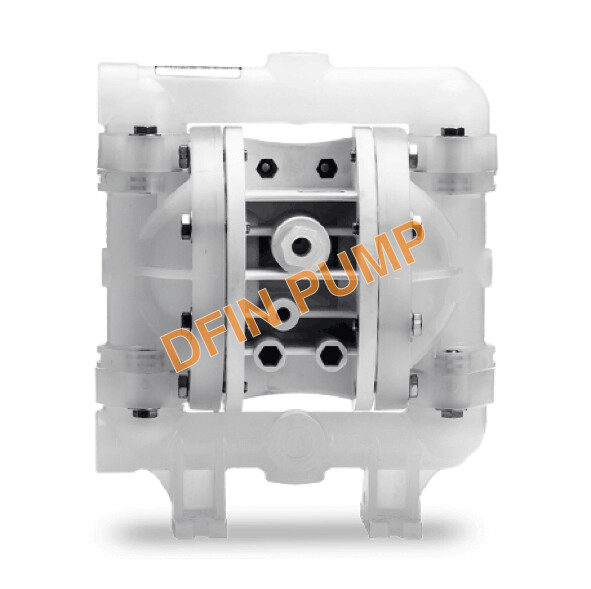
DFIN’s P100 catalog item 01-10310 is one documented configuration, not a universal match for every P100. Its catalog photograph is a product reference; confirm the requested construction and complete model before ordering. The page lists air- and wet-end kit references for that item, but kit compatibility must still be checked against the installed pump and repair scope. Compare options in the WILDEN product range if the duty or material requirement has changed.
What should a maintenance or purchasing request include?
- Full pump model and item number, with clear nameplate and installed-pump photos.
- Whether the pump never primes, loses prime, or gives low flow only at high cycle rate.
- Liquid, concentration, temperature, approximate viscosity and any solids or abrasive content.
- Tank level, vertical suction lift, suction-hose length and material, strainer condition and discharge pressure.
- Parts inspected, visible wear, any previous repair and whether liquid reached the air exhaust.
- Required quantity, destination and whether you need an individual part, a wet-end kit or a complete pump.
Send this record through the DFIN quotation form. A useful quotation should identify the exact configuration and repair scope. Price depends on materials, kit contents, quantity and delivery destination; ask for a matched offer rather than assuming one P100 price fits every version.
FAQ
Can a P100 cycle normally while its suction line leaks air?
Yes. The air motor can keep cycling while a vacuum-side joint draws air instead of liquid. An inlet leak may show no outward drip. Verify the joint and the complete suction path before opening the liquid end.
Should I replace the air valve when the pump cycles but does not prime?
Not on that symptom alone. First check the source, inlet path, suction lift, operating rate, discharge and liquid-end checks. Air-valve diagnosis becomes more relevant when the pump stalls, cycles abnormally or has excessive air leakage.
Does a new check-ball set guarantee that priming returns?
No. A blocked hose, air leak, unsuitable suction arrangement or fluid incompatibility can produce the same complaint. Inspect balls, seats and seals together and correct the root cause before fitting matched replacements.
What is the fastest way to get the correct P100 repair quote?
Provide the complete model and item number, nameplate and part photos, fluid conditions, observed symptom and the requested repair scope. State whether the image or catalog item is only a reference. DFIN can then confirm the applicable pump or parts rather than guessing from “P100.”