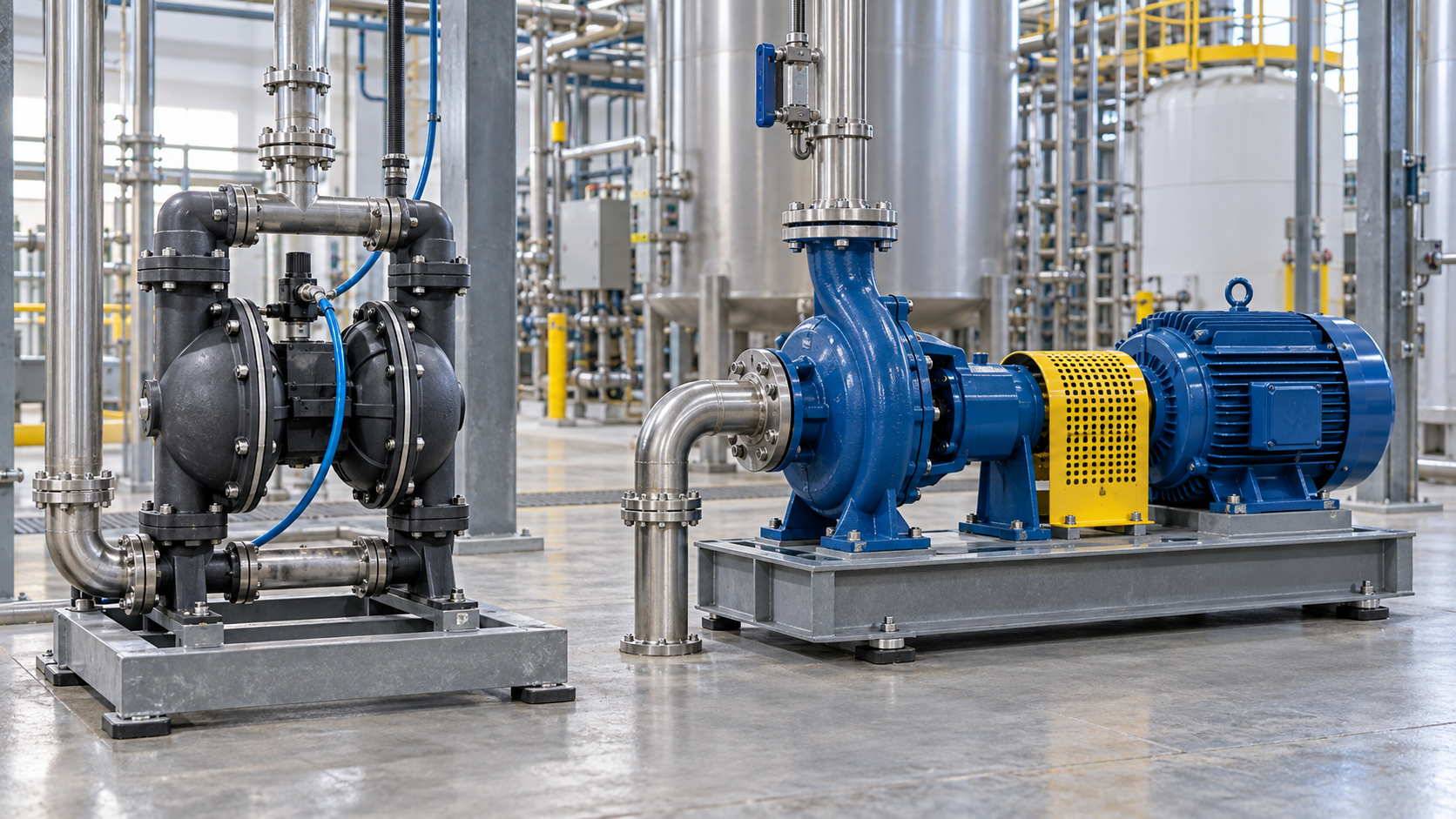
Choose an AODD pump when the chemical-transfer duty includes emptying drums or totes, suction lift, intermittent dry running, entrained air, solids, changing viscosity or a strong need to avoid a rotating shaft seal. Choose a centrifugal pump when the liquid is clean and relatively low in viscosity, the suction is reliably flooded, the required flow is smooth and continuous, and energy efficiency over long operating hours is a priority.
Neither technology is universally better. The correct answer depends on the complete system: chemical compatibility, temperature, viscosity, solids, vapor pressure, suction conditions, flow and pressure, operating hours, area classification, allowable pulsation, containment strategy, utilities and maintenance capability. This guide compares the two technologies so engineers and buyers can prepare a more accurate pump enquiry.
AODD pump vs centrifugal pump at a glance
| Selection factor | AODD pump | Centrifugal pump |
|---|---|---|
| Operating principle | Reciprocating positive displacement driven by compressed air | Rotodynamic pump driven by a motor or other rotating driver |
| Typical best fit | Variable, intermittent or difficult transfer duties | Stable, continuous transfer of clean, low-viscosity liquid |
| Priming | Inherently self-priming; model-specific lift must be checked | Usually needs flooded suction or a defined priming arrangement unless designed as self-priming |
| Dry running | Generally tolerant, subject to model, material and operating limits | Normally requires protection against loss of liquid |
| Flow quality | Pulsating; a dampener may be required | Smooth, continuous flow |
| Solids and entrained air | Often more tolerant when valve and passage size are suitable | Depends strongly on impeller design and suction stability |
| Energy source | Compressed air | Usually an electric motor |
| Containment | No rotating process shaft seal; diaphragm condition remains critical | Commonly uses a mechanical seal, although sealless designs also exist |
| Operating cost | Air consumption can dominate continuous-duty cost | Often more efficient for steady, correctly sized continuous duty |
The table is a screening guide, not a substitute for a model curve or materials review. An AODD pump can be a poor choice when compressed-air cost is high and the duty is continuous. A standard centrifugal pump can be a poor choice when the suction repeatedly ingests air, the container empties, or the liquid changes sharply in viscosity.
How the two pump types move liquid
An air-operated double-diaphragm pump alternately pressurizes two air chambers. The linked diaphragms displace liquid while inlet and discharge check valves control direction. Because the liquid is moved in strokes, flow is pulsating and changes with air pressure, air volume, discharge resistance and pump speed.
A centrifugal pump adds velocity to liquid with a rotating impeller and converts part of that velocity into pressure. Its operating point is where the pump curve intersects the system curve. Flow therefore changes with total head, impeller diameter, speed and the hydraulic resistance of the installation.
Choose an AODD pump for drums, totes and variable suction
Drum unloading, IBC transfer, sump evacuation and batch duties often expose a pump to suction lift, air ingestion and an empty source vessel. These conditions favor AODD technology. Official Wilden information describes AODD pumps as self-priming, dry-run capable and able to deadhead. Those characteristics can simplify portable or intermittent transfer where a standard centrifugal pump may repeatedly lose prime.
Do not use a general self-priming claim as a guaranteed suction-lift value. Dry and wet lift differ, and performance changes with pump size, valve configuration, air pressure, liquid density and viscosity. Size the suction pipe generously, minimize restrictions and confirm the actual model curve.
Choose a centrifugal pump for stable continuous flow
For clean, low-viscosity liquid with reliable flooded suction, a centrifugal pump often provides smoother flow and lower energy cost during long operating hours. The U.S. Department of Energy notes that centrifugal pumps handle high flow rates and provide smooth, nonpulsating delivery. Their efficiency depends on matching the pump to the required operating range rather than selecting a large pump and throttling away excess head.
Hydraulic Institute guidance emphasizes operation near the best efficiency point and within the preferred operating region. Persistent operation far from that range can increase recirculation, vibration, radial loading, heat and wear. Ask for a curve showing the duty point, efficiency, power and NPSH requirement.
Viscosity can reverse the decision
A centrifugal pump selected on water-like data may deliver much less flow and consume more power when viscosity rises. AODD pumps are commonly considered for viscous products because positive displacement does not depend on developing impeller velocity in the same way. However, high viscosity also reduces AODD filling efficiency, increases suction losses and may require a lower cycle rate and larger piping.
Provide viscosity at the lowest start-up temperature as well as at normal operation. If the product is non-Newtonian, state whether the quoted value is apparent viscosity and include the test conditions. Do not select either pump from a room-temperature viscosity value when the process can start cold.
Solids, crystals and abrasives require more than a pump-type label
An AODD pump can pass suspended solids when the particle size, shape and concentration fit the valve and liquid-passage design. It can also operate at lower liquid velocity than some centrifugal selections. That does not make every AODD pump abrasion-proof: balls, seats, diaphragms and manifolds can still wear.
Centrifugal pumps can handle solids when they are purpose-designed with a suitable impeller and passage geometry. A clean-liquid centrifugal pump should not be assumed suitable for slurry. For either technology, state the maximum particle dimension, percentage by volume or mass, hardness, shape, settling tendency and whether crystals can grow during shutdown.
Chemical compatibility covers every wetted component
Compatibility must be checked against the exact chemical name, concentration and temperature. For an AODD pump, review the body, manifolds, diaphragms, valve balls, seats and O-rings. For a centrifugal pump, review the casing, impeller, shaft or sleeve, wear components, mechanical-seal faces and elastomers.
PTFE, elastomers, polypropylene, PVDF, stainless steel and other materials each have limits. A material that resists the liquid chemically may still be unsuitable because of abrasion, permeation, temperature cycling or mechanical fatigue. Use current manufacturer compatibility data and confirm uncertain duties with the material supplier.
Containment and leakage risk
An AODD pump has no rotating shaft passing through the liquid end, removing the conventional dynamic mechanical-seal location. This can be valuable for corrosive, hazardous or leak-sensitive transfer. The diaphragm is still a pressure boundary, so inspection, service interval and failure detection remain important.
A conventional centrifugal pump commonly relies on a mechanical seal. Seal reliability depends on material selection, lubrication, flushing, alignment, vibration and operation. Where the consequence of leakage is high, compare an AODD pump with a sealless centrifugal or magnetic-drive alternative rather than assuming every centrifugal design has the same containment risk.
Air consumption versus electrical efficiency
Compressed air is convenient and can support simple speed control, but it is an expensive plant utility when leaks, pressure drop and compressor inefficiency are included. A continuously operating AODD pump should be evaluated at the real duty point using the manufacturer's air-consumption curve, compressor free-air delivery and the local cost of compressed air.
A correctly sized centrifugal pump can be more economical for stable continuous service, especially when it operates near its efficient range. Oversizing, control-valve throttling, bypass flow and poor pipe sizing can erase that advantage. Compare complete system energy, not only motor nameplate power or pump purchase price.
Flow control, pulsation and instrumentation
AODD flow can be adjusted through air pressure and air volume, but reducing one is not equivalent to reducing the other. Backpressure changes cycle rate and delivered flow. Where a flowmeter, filter, spray nozzle or dosing step is sensitive to pulsation, evaluate a correctly sized pulsation dampener and the required control method.
Centrifugal pumps provide smoother flow. Flow may be controlled by a variable-speed drive, a control valve or system design, but the selected method must keep the pump within an acceptable operating region. If accurate batch quantity is required, specify the measurement and shutoff method rather than assuming either technology is a metering pump.
Suction conditions and cavitation
Both technologies need a properly designed inlet. For a centrifugal pump, compare NPSH available with the model's NPSH requirement across the expected operating range, with an appropriate engineering margin. High temperature, vapor pressure, suction lift, clogged strainers and small piping reduce the available margin.
AODD pumps can self-prime, but restrictive suction conditions still reduce flow and can damage components. Long hoses, small fittings, collapsing hose, viscous liquid and high cycle rate can prevent complete chamber filling. For vacuum or lift service, provide the vertical lift, total suction length, pipe size and liquid properties.
Blocked discharge and dry-run protection
An air-operated diaphragm pump normally stalls when air pressure and discharge pressure balance, then resumes when the restriction is removed. This is useful, but it does not replace a risk review. Trapped liquid can heat or expand, components have pressure limits, and downstream equipment may require separate protection.
A centrifugal pump should not be operated indefinitely against a closed discharge or without liquid unless the exact system is designed for it. Define minimum-flow protection, dry-run detection, tank-level interlocks, pressure limits and safe shutdown logic for the complete installation.
Maintenance differences
AODD maintenance commonly involves diaphragms, valve balls or flaps, seats, O-rings and air-valve components. Service life depends on cycle rate, chemical compatibility, abrasion, temperature and air quality. Keeping the exact wet-side and air-side kits for the full pump code can reduce downtime.
Centrifugal maintenance commonly includes bearings, seals, wear rings or other wear components, alignment and condition monitoring. A stable, correctly aligned installation can run for long periods, while operation away from the intended region can shorten component life. Compare accessibility, skills, spares and the consequence of downtime.
Which pump costs less?
There is no responsible universal price answer. AODD pump cost changes with size, body material, diaphragm and valve materials, air system, dampener, certification and controls. Centrifugal pump cost changes with hydraulic size, metallurgy, seal plan or magnetic drive, motor, baseplate, coupling, guard, variable-speed drive and instrumentation.
Compare total installed cost and total ownership cost: purchase, piping changes, air or electricity, expected operating hours, maintenance labor, spare parts, leakage consequence, cleaning, downtime and replacement interval. For intermittent drum transfer, operational flexibility may outweigh energy efficiency. For a stable process running continuously, energy may dominate the lifecycle calculation.
Practical decision sequence
- If the source can empty, the pump must lift liquid, or air ingestion is frequent, start by evaluating AODD.
- If the liquid is clean, thin, continuously available and the duty is steady, evaluate centrifugal first.
- If solids, viscosity or shear sensitivity are important, compare them against the exact model design.
- If leakage has serious safety or environmental consequences, compare containment strategies, not just pump names.
- Calculate suction losses, required flow and total differential pressure for the real installation.
- Compare compressed-air consumption with electrical energy at the actual operating point.
- Review materials, certifications, controls, maintenance access and spare-parts strategy.
- Confirm the selected model on a current manufacturer curve before ordering.
RFQ checklist for AODD or centrifugal pump selection
- Full chemical name, concentration and safety data where applicable
- Density, viscosity at start and operation, vapor pressure and temperature range
- Solids size, concentration, hardness and settling behavior
- Minimum, normal and maximum flow
- Suction pressure or lift, discharge pressure and total pipe losses
- Operating hours, batch frequency and expected control method
- Required wetted materials and leakage or hygiene requirements
- Available compressed-air pressure and capacity, or electrical supply
- Area classification, required approvals and documentation
- Connection standard, quantity, destination and requested spare kits
Send these details through the DFIN pump selection RFQ. For AODD applications, also review the AODD sizing guide, diaphragm material guide and compressed-air sizing guide.
Frequently asked questions
Is an AODD pump always better for chemicals?
No. AODD is attractive for difficult suction, intermittent service, variable liquids and duties where a rotating shaft seal is undesirable. A centrifugal pump may be better for clean, low-viscosity, continuous high-flow service when the materials and containment design are appropriate.
Which pump is more energy efficient?
A correctly selected centrifugal pump is often more energy-efficient for continuous stable duty. AODD economics depend heavily on air consumption, compressor efficiency and operating hours. Compare both technologies at the actual duty point.
Can an AODD pump run dry?
Many AODD pumps are designed to tolerate dry running, but the exact model, materials, speed and service conditions still matter. Dry-running capability should not be interpreted as permission to ignore monitoring or maintenance.
Can a centrifugal pump handle corrosive liquid?
Yes, when the casing, impeller, shaft, seal and elastomers are compatible and the system provides suitable suction and seal conditions. For severe leak-sensitive service, also evaluate sealless centrifugal or magnetic-drive designs.
Which pump is better for slurry?
It depends on particle size, concentration, hardness, flow and duty cycle. An AODD pump is often useful for intermittent, abrasive or air-entrained slurry, while a purpose-designed solids-handling centrifugal pump may be preferable for continuous high-flow service.
Related DFIN resources
- Chemical-processing pump applications
- Browse WILDEN pump configurations
- WILDEN P2 product reference
- WILDEN XPS8 product reference
- Explore KSB centrifugal pump families
- How to select a WILDEN AODD pump for chemical transfer
- Contact DFIN Pump
Technical references
- Wilden: principles of AODD pump operation
- Wilden Pro-Flo Series brochure
- U.S. Department of Energy: Improving Pumping System Performance
- Hydraulic Institute pump FAQs and BEP guidance
Application guidance only. Confirm the current performance curve, materials, temperature, pressure, air or power requirement, NPSH, solids passage, seals or diaphragms, area classification, controls and protection for the exact pump configuration before purchase or commissioning.