To size the compressed-air supply for an air-operated double-diaphragm (AODD) pump, first locate the required liquid flow and discharge pressure on the exact pump performance curve. Read the air inlet pressure and air consumption at that operating point, then confirm that the compressor, receiver, header, branch line, regulator and fittings can deliver that airflow at the pump while other equipment is running. Air pressure alone is not enough: the pump also needs adequate air volume.
Start with the pump operating point
Do not size the air system from the pump port size, maximum flow or maximum air pressure. Begin with the duty the process actually requires:
- Required liquid flow at normal and peak conditions
- Total discharge pressure, including static head, pipe friction, valves, filters and process equipment
- Suction lift or flooded suction condition
- Fluid viscosity, temperature, solids and specific gravity
- Expected operating hours and whether the duty is continuous or intermittent
Use the performance curve for the exact pump size, diaphragm configuration and test basis. Published maximum flow normally represents favorable test conditions and is not a reliable compressor-sizing value.
How to read AODD pump air consumption from a performance curve
- Find the required liquid flow on the horizontal axis.
- Move to the required discharge pressure on the vertical axis.
- Identify the air inlet pressure curve that passes through the operating point.
- Read the air-consumption contour at the same point, usually stated in SCFM, Nm³/h or another standard-air unit.
Wilden’s performance-curve guidance uses an example operating point of 90 gpm at 50 psig discharge pressure. The illustrated curve indicates about 90 psig inlet pressure and approximately 72 SCFM air consumption. Those figures demonstrate the reading method only; they are not universal values for other pumps or duties.
Pressure and airflow solve different problems
Air pressure provides the force needed to overcome liquid-side resistance. Airflow provides the volume needed to keep the diaphragms cycling at the required rate. A gauge may show adequate static pressure while an undersized hose, regulator, quick coupling or header starves the pump during operation.
If pressure at the pump drops sharply when the pump accelerates, check dynamic pressure and airflow at the inlet rather than increasing the regulator setting automatically. Excessive pressure can raise air consumption and wear without correcting a restricted supply line.
Size the compressor from delivered air, not nameplate horsepower
Compare the pump requirement with the compressor’s rated free-air delivery at the required pressure. Do not rely only on motor horsepower or displacement. Compressor output changes with pressure, control method, ambient conditions and package configuration.
For several air users, calculate the peak simultaneous demand:
Required delivered airflow = sum of simultaneous pump demand + other simultaneous air demand + an engineering allowance for leakage, control behavior and future uncertainty.
The allowance should be chosen using the plant’s measured leakage, compressor controls and operating pattern. An arbitrary percentage cannot replace a demand study when production depends on the air system.
Illustrative compressor check
If an exact pump curve shows 72 SCFM at the required duty, the compressor system must deliver at least that volume at the required pressure after accounting for every simultaneous consumer and pressure loss. Wilden’s example converts 72 SCFM to an approximate 16 hp compressor using SCFM ÷ 4.5, then rounds to a standard 20 hp size. Treat this as a screening example, not a purchasing specification: verify the selected compressor’s published FAD at pressure.
Check the complete air path
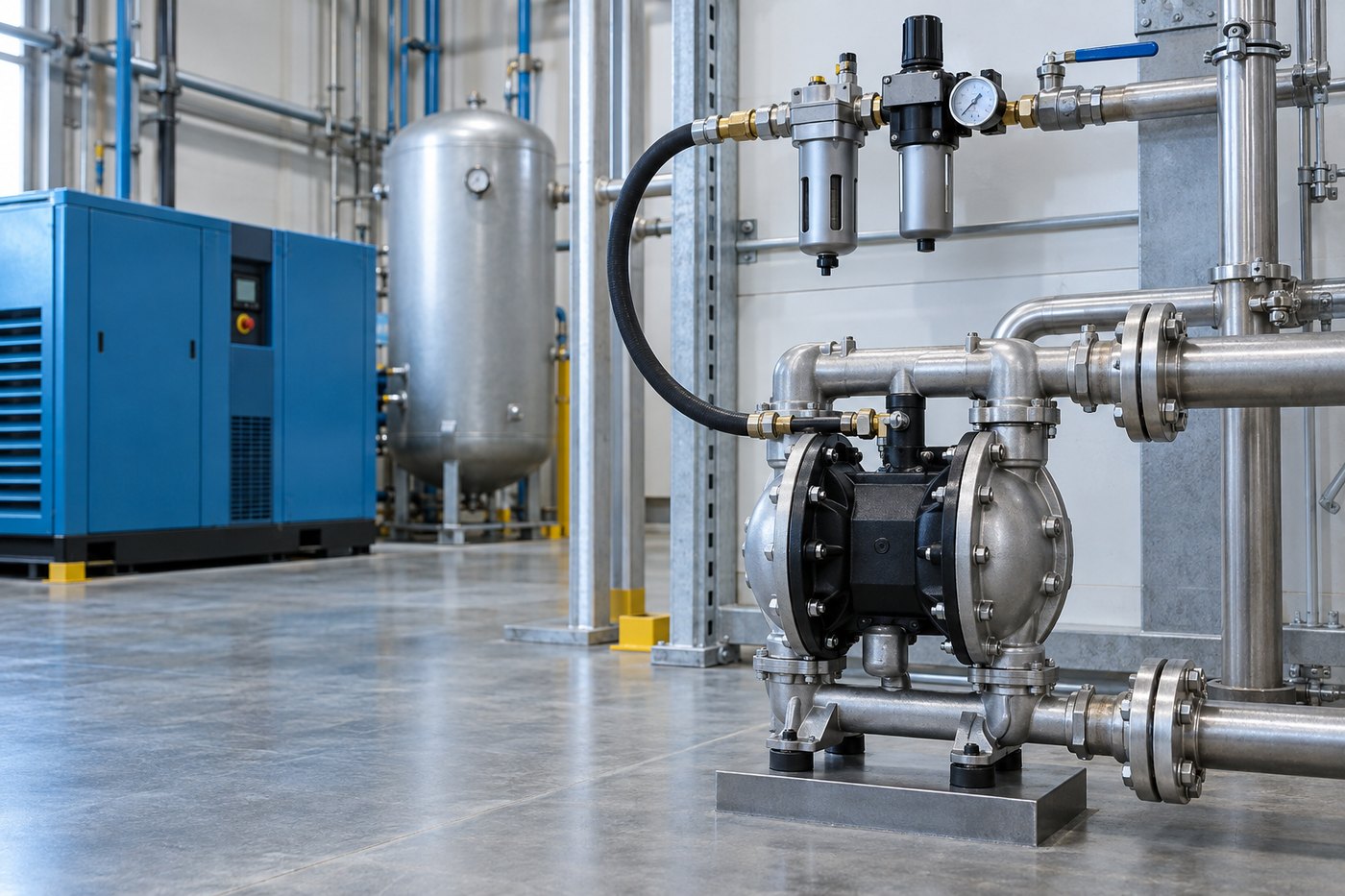
A correctly sized compressor cannot compensate for a restrictive distribution system. Review each component between the receiver and pump:
- Main header and branch-line internal diameter
- Hose length, bore and material
- Filter and regulator flow capacity at the chosen pressure
- Quick couplings, shutoff valves, elbows and silencers
- Pressure drop when all expected equipment is operating
- Water, oil and particulate control required by the pump manual
Specify regulators and filters by rated flow and acceptable pressure drop, not connection size alone. Use a pressure gauge close to the pump inlet, and record pressure while the pump is delivering the required liquid flow.
Prevent cold exhaust and icing problems
Expanding compressed air cools as it exhausts. High cycling rates, moisture in the air, low ambient temperature or a restricted muffler can promote icing and unstable operation. Corrective work may include improving air drying and drainage, reducing unnecessary cycling, checking the exhaust path and selecting an appropriate pump or air-system arrangement. Follow the pump manufacturer’s lubrication guidance; adding a lubricator to a pump designed for oil-free operation may create maintenance problems.
Estimate compressed-air operating cost
For purchasing decisions, compare pumps at the same liquid operating point. Total SCFM alone can be misleading if the pumps deliver different liquid flow. A useful plant metric is standard air consumed per unit of liquid transferred.
A basic annual estimate is:
Annual air cost = air consumption at duty × operating hours × site-specific compressed-air cost.
Use the facility’s measured cost per standard volume of compressed air, including electricity and relevant maintenance assumptions. Electricity tariffs, compressor efficiency, load profile and leakage vary widely, so a generic price should not be presented as a customer quotation.
Common sizing mistakes
- Selecting a compressor from pump inlet pressure while ignoring SCFM or Nm³/h
- Using the pump’s maximum-flow point instead of the real operating point
- Ignoring simultaneous demand from other pumps and pneumatic equipment
- Sizing hose, regulators or couplings only by nominal connection size
- Comparing compressor horsepower without checking delivered-air data at pressure
- Increasing air pressure to compensate for suction or discharge restrictions
- Assuming one performance curve applies to every diaphragm and valve configuration
Information to include in an AODD pump RFQ
Send the fluid, viscosity and temperature; solids details; required flow; suction condition; discharge pressure; pipe sizes and lengths; operating hours; available air pressure; available air volume; compressor type; air quality; number of simultaneous air users; hazardous-area requirements; and any existing pump model. This allows the pump and air supply to be reviewed as one system.
Frequently asked questions
Can I size an AODD pump from PSI alone?
No. PSI indicates pressure, while SCFM or Nm³/h indicates standard airflow. The pump needs enough of both at the operating point.
Why does my pump lose flow even though the pressure gauge looks normal?
The gauge may show static pressure but not the pressure available during peak airflow. A small hose, undersized regulator, restrictive coupling, shared branch line or inadequate compressor delivery can cause dynamic pressure loss.
Should I use maximum pump air consumption for compressor sizing?
Use the exact performance curve at the required duty, then evaluate peak and future conditions. Maximum consumption may be useful as a boundary, but it can oversize the system if the pump never operates there.
Can one compressor supply several diaphragm pumps?
Yes, if its delivered capacity, receiver and distribution system can support the peak simultaneous demand at the required pressure. Diversity assumptions should reflect the real operating sequence.
Does a larger air connection always solve low flow?
No. The restriction may be elsewhere, and low liquid flow can also result from suction lift, viscosity, blocked valves, worn wet-side parts or excessive discharge resistance. Diagnose both air and liquid sides.
Related DFIN resources
- AODD pump low-flow troubleshooting
- Browse complete pumps
- Browse AODD repair kits and spare parts
- Request pump and air-supply selection support
Technical reference
Application guidance only. Confirm the exact pump curve, air-system capacity, installation requirements and current manufacturer documentation before ordering.