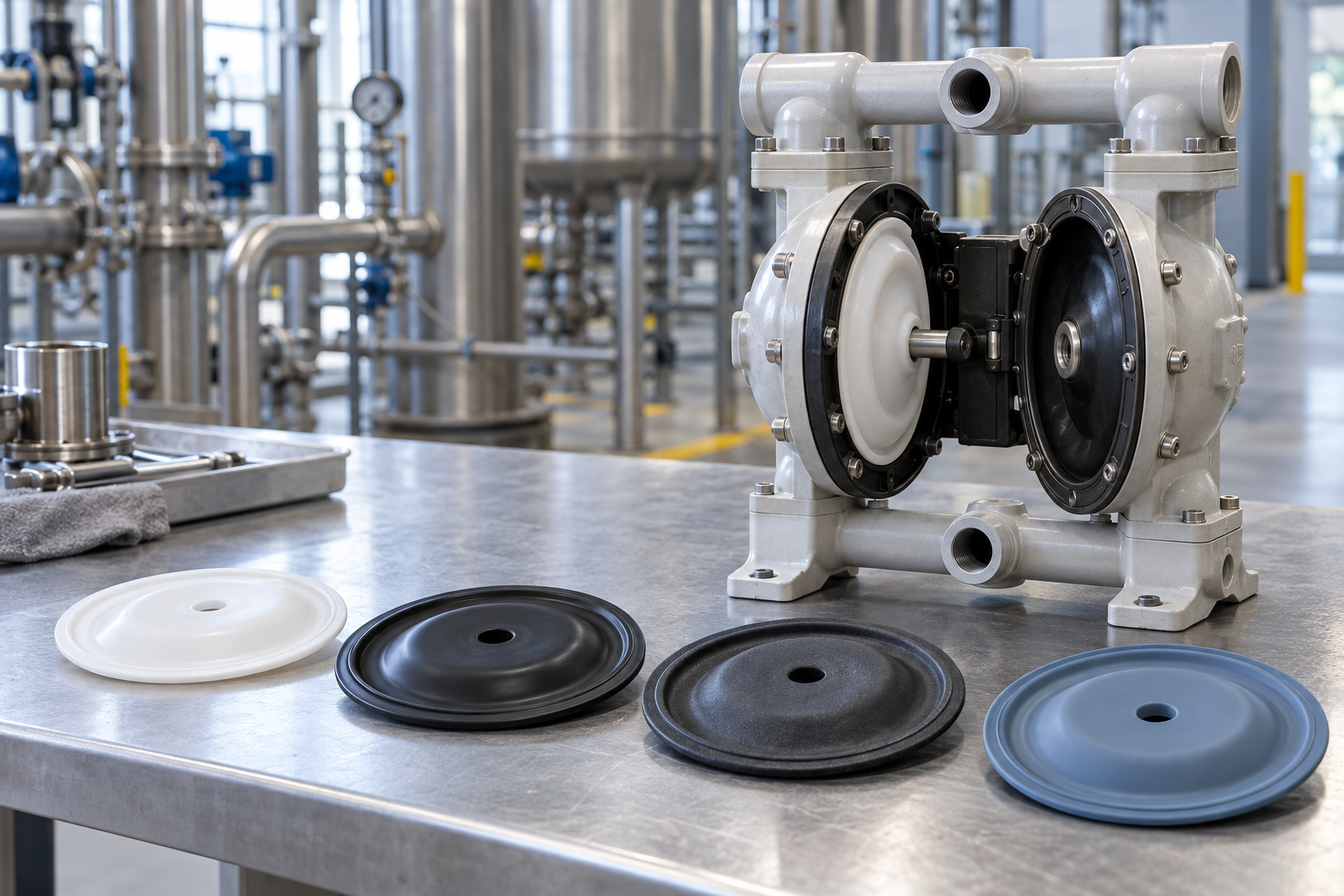
The safest way to select an AODD pump diaphragm is to match the complete duty—not just the chemical name—to a current manufacturer compatibility chart. Record the exact fluid, concentration, normal and cleaning temperatures, suspended solids, cycle rate and compliance requirements. PTFE is often considered first for aggressive chemicals; NBR is commonly evaluated for oils; EPDM for many water-based, acidic or caustic services; and a TPE such as Santoprene-type material for duties that need a balance of flex life and abrasion resistance. These are starting points, not universal approvals.
A diaphragm is both a moving component and a barrier between the pumped liquid and the air section. A poor material choice can cause swelling, hardening, cracking, loss of stroke, contamination or unexpected downtime. The correct choice must also match the balls, seats, O-rings and pump body—not only the diaphragm.
Information required before selecting a diaphragm
Give the supplier enough detail to review the real service conditions. A request that only says “chemical,” “oil” or “wastewater” is not sufficient.
- Exact fluid name and all important ingredients
- Concentration or mixture ratio, including cleaning chemicals
- Normal, minimum and maximum liquid temperature
- Presence, size, hardness and percentage of suspended solids
- Viscosity and whether it changes with temperature
- Required flow, discharge pressure and expected pump speed
- Continuous or intermittent operation and annual operating hours
- Food, pharmaceutical, conductivity or other compliance needs
- Existing pump brand, model, size and current wet-end materials
Quick comparison of common AODD diaphragm materials
The table below is a screening guide. Final compatibility depends on the manufacturer’s formulation, the complete fluid mixture and operating temperature.
| Material family | Typical reason to consider it | Questions to verify | Purchasing note |
|---|---|---|---|
| PTFE | Broad chemical resistance for many aggressive acids, caustics and solvents | Backing diaphragm, abrasion, stroke design, temperature and exact pump configuration | Compare the complete assembly and expected downtime, not diaphragm price alone |
| EPDM | Many water-based, acidic and caustic services | Oil or hydrocarbon exposure, cleaning chemicals and temperature | Confirm the exact grade and every wetted component |
| NBR / Buna-N | Many oils, lubricants and petroleum-related fluids | Solvents, oxidizers, ozone exposure and temperature | A low initial price is not economical if the material swells or hardens |
| TPE / Santoprene-type | Flex life, abrasion resistance and general industrial duty | Strong solvents, oxidizers, concentration and hygiene grade | Check whether the offered part is an OEM design or a verified equivalent |
| FKM | Selected oils, fuels, solvents and higher-temperature duties | Compatibility with bases, amines and the exact chemical mixture | Use the current supplier chart; “FKM” alone does not define every formulation |
When PTFE is the logical starting point
PTFE is widely evaluated when chemical resistance is the dominant risk. Wilden describes PTFE diaphragms as suitable for aggressive applications and offers several diaphragm designs and backup-material options. Because pump construction varies, do not assume that a PTFE part can directly replace an elastomeric diaphragm.
Confirm whether the assembly requires a backup diaphragm, special inner or outer plates, a reduced-stroke configuration or different torque procedures. Also review solids and abrasion: excellent chemical resistance does not automatically produce the longest service life in every abrasive slurry.
When EPDM, NBR or TPE may be a better fit
EPDM
EPDM is commonly assessed for many aqueous solutions, acids, caustics and cleaning duties. It is usually not the first material considered for mineral oils and many hydrocarbons. Temperature and concentration can change the result, so verify both the process liquid and every cleaning or flushing chemical.
NBR or Buna-N
NBR is often considered for oils, greases, lubricants and some fuel-related services. It may be unsuitable for other solvent or oxidizing duties. Ask whether the diaphragm will also contact detergents, additives or intermittent cleaning chemicals that were omitted from the original specification.
TPE and Santoprene-type materials
Thermoplastic elastomers are frequently chosen when repeated flexing, abrasion resistance and general industrial durability are important. Wilden’s TPE range includes materials intended for different chemical and hygienic duties. Treat trade names as specific product families: compatibility and regulatory claims must be checked for the exact grade supplied.
Check the whole wetted path
A compatible diaphragm cannot protect incompatible balls, seats, O-rings, manifolds or hardware. Review the complete material combination as one system. For example, a pump may use a PTFE diaphragm but still have an elastomeric backup, seals or valve components that limit the application.
Also check air-side exposure. A diaphragm breach can allow process liquid into the center section or exhaust. Hazardous, toxic or high-value fluids may require leak detection, controlled exhaust arrangements or additional containment measures.
Temperature, concentration and mixtures change compatibility
A compatibility rating at room temperature is not automatically valid at the process maximum. Heat can accelerate swelling, softening or chemical attack. Mixtures can behave differently from their individual ingredients, and trace solvents or cleaning agents may control the selection.
Use the highest credible process and cleaning temperature. If the composition varies by batch, provide the complete operating range and identify upset conditions. When reliable compatibility data is unavailable, request manufacturer guidance and consider controlled testing before committing the pump to production.
Abrasion and cycle rate affect service life
Solids can wear a chemically compatible material, while high cycle rates increase flexing stress. If the pump is running very fast to meet normal demand, a larger pump operating more slowly may reduce air consumption and mechanical wear. Review suction conditions and discharge restrictions as well, because cavitation-like inlet starvation and excessive backpressure can shorten diaphragm life.
Food, pharmaceutical and high-purity service
Do not infer hygienic suitability from a material name. Request documentation for the exact diaphragm grade and pump configuration, including any applicable food-contact or pharmaceutical declarations. Surface finish, cleanability, drainability, fasteners, lubricants and traceability may be just as important as the diaphragm polymer.
How diaphragm choice affects price and total cost
Diaphragm pricing depends on material, pump size, one-piece or multi-piece design, backup components, brand, certification and quantity. A universal online price can be misleading because two parts with a similar diameter may not have the same geometry or assembly requirements.
Compare total cost instead:
- Purchase price of the complete wet-side kit
- Expected inspection and replacement interval
- Labor and production downtime
- Risk and cleanup cost of a leak or contamination event
- Availability of verified replacement parts
- Air consumption and output at the required operating point
For an accurate quotation, provide the pump model, item number if available, diaphragm markings, clear photos and the full application data. Do not order by color or approximate diameter alone.
Common diaphragm-selection mistakes
- Checking the chemical name but ignoring concentration and temperature
- Reviewing the diaphragm while ignoring balls, seats and O-rings
- Assuming all PTFE, EPDM, NBR or TPE formulations are identical
- Changing material without checking the required backup and hardware
- Using a food-grade claim that does not cover the exact supplied part
- Buying by appearance instead of pump model and item number
- Choosing the lowest part price without considering downtime
RFQ checklist for diaphragm selection
Send the pump manufacturer, full model, size, serial number and current diaphragm code; fluid name and composition; concentration; temperature range; viscosity; solids; required flow and pressure; operating hours; cleaning method; existing failure symptoms; regulatory requirements; and photos of the pump nameplate and removed parts. This information allows the supplier to check both material compatibility and mechanical fit.
Frequently asked questions
Is PTFE always the best AODD diaphragm material?
No. PTFE is a strong starting point for many aggressive chemicals, but abrasion, flexing, pump design, backup requirements, temperature, output and total cost can make another material more appropriate.
Can I replace an EPDM diaphragm with PTFE?
Only after confirming chemical compatibility and the complete pump assembly. The PTFE option may require different backup diaphragms, plates, stroke geometry or installation procedures.
Why did a chemically compatible diaphragm fail early?
Possible causes include excessive cycle rate, solids abrasion, incorrect assembly, over-torque, inlet starvation, high temperature, incompatible cleaning chemicals or another worn wet-side component. Inspect the whole system before replacing the same part.
What information is needed for a diaphragm price?
At minimum, provide the exact pump model and size, diaphragm material or item number, quantity and destination. For a material change, also provide complete fluid and operating data so the quotation does not create an application risk.
Related DFIN resources
- How to select an AODD pump for chemical transfer
- AODD pump low-flow troubleshooting
- Browse AODD repair kits and wet-side parts
- Request material selection and quotation support
Technical references
- Wilden PTFE diaphragm materials
- Wilden thermoplastic elastomer diaphragm materials
- Graco AODD pump material selection overview
Application guidance only. Confirm current chemical-resistance data, temperature limits, regulatory documentation and installation instructions for the exact pump and component before ordering or commissioning.