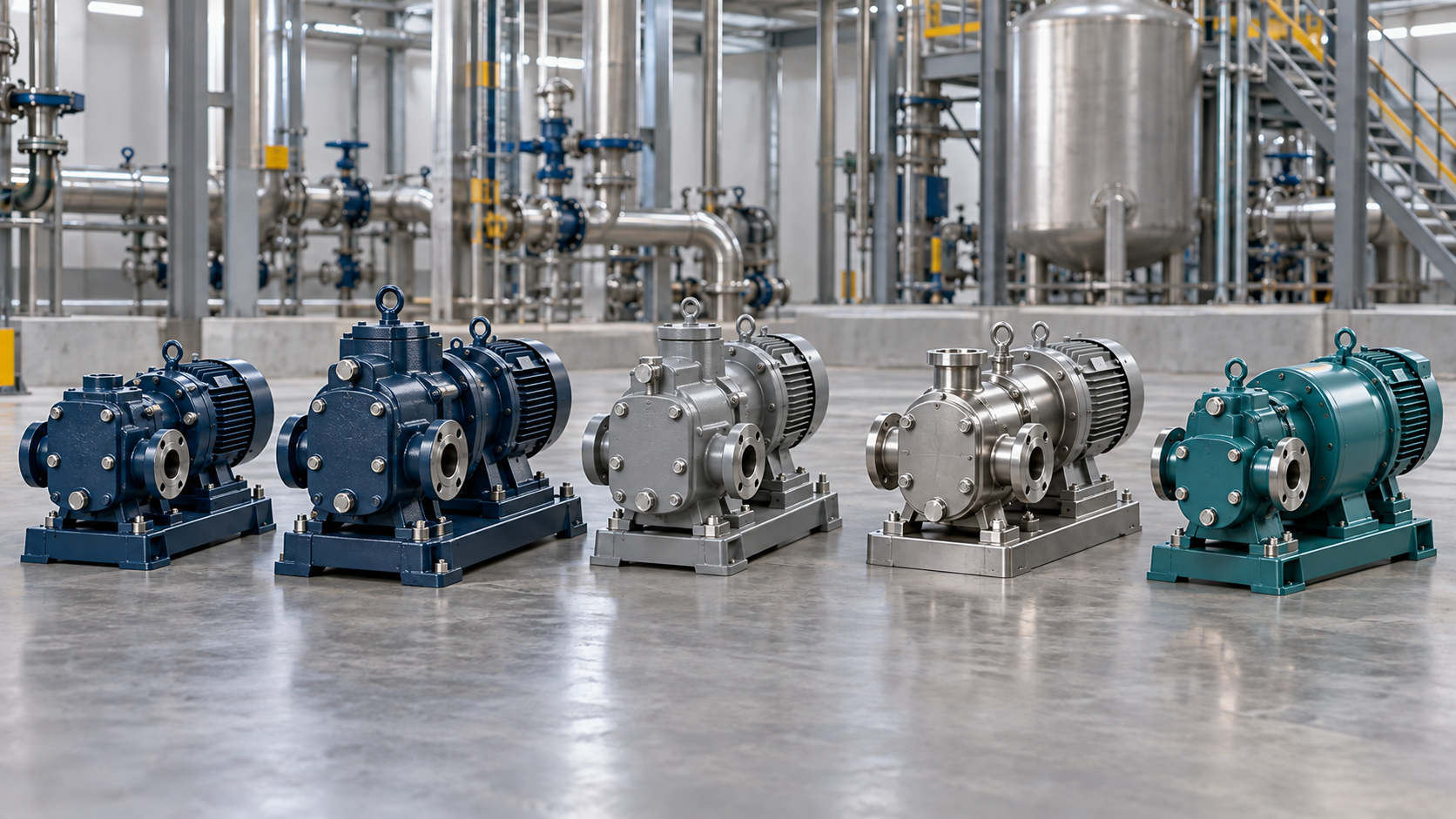
Choose a DESMI ROTAN series from the liquid and service risk—not from flow alone. GP is the compact general-purpose choice for clean, non-abrasive liquids. HD is intended for demanding, high-viscosity, non-corrosive service. PD uses a carbon-steel construction for refinery and petrochemical duties. CD uses stainless-steel wetted construction for corrosive or special liquids. ED is a magnetically coupled, sealless option where leakage control is the overriding requirement.
The series name is only the first decision. Final selection still requires the real flow, differential pressure, viscosity at starting and operating temperature, vapor pressure, solids, lubricity, chemical compatibility, sealing plan, connection standard, motor and installation conditions. This guide helps an engineer or buyer narrow the family before the exact size and configuration are checked against current manufacturer data.
ROTAN GP vs HD vs PD vs CD vs ED at a glance
| Series | Primary construction or design | Typical selection reason | Published range limit* |
|---|---|---|---|
| GP | Compact cast-iron general-purpose pump | Clean, non-abrasive oils and similar liquids | Up to 50 m³/h, 7,500 cSt and 150°C |
| HD | Heavy-duty cast-iron pump | Viscous, non-corrosive and demanding duties | Up to 250 m³/h, 250,000 cSt and 250°C |
| PD | Carbon-steel petrochemical-duty pump | Fuel, hydrocarbons and refinery applications | Up to 250 m³/h, 250,000 cSt and 250°C |
| CD | Stainless-steel chemical-duty pump | Corrosive chemicals and special fluids | Up to 250 m³/h, 250,000 cSt and 250°C |
| ED | Magnetically coupled sealless pump in multiple material options | Toxic, hazardous, crystallizing or leak-sensitive service | Up to 90 m³/h, 10,000 cSt and 250°C |
*These are family-level maximum values published in DESMI's industry overview, not one simultaneous duty point and not a guarantee for every size or configuration. The overview lists differential pressure up to 16 bar and speed up to 1,750 rpm across these families. Always use the curve, allowable pressure, temperature limit and material data for the complete product code.
Start with the liquid before choosing the pump series
Record the full liquid name, composition and concentration. Include viscosity at the lowest start-up temperature and at the normal operating temperature, because a heated oil, resin or bitumen can require far more torque before it reaches process temperature. State density, vapor pressure, lubricity, abrasiveness, solids size and concentration, shear sensitivity, tendency to crystallize or polymerize, and whether the liquid is hazardous or flammable.
Internal gear pumps are positive-displacement pumps. Flow is broadly proportional to speed, but internal slip changes with viscosity, differential pressure and clearances. A catalog displacement value is therefore not enough to select the operating speed or motor. Use a configuration-specific curve or selection calculation.
Choose ROTAN GP for clean general-purpose liquids
ROTAN GP is the compact cast-iron family for clean, non-abrasive liquids. DESMI lists applications such as clean oil, lubricating oil, glycol, vegetable oil, fish oil, waste oil and solvents. It can suit OEM packages and straightforward transfer or circulation duties when the material and sealing arrangement are compatible.
Do not select GP merely because it has the lowest expected package cost. If viscosity, temperature, duty cycle or mechanical loading is severe, HD may provide a better service margin. If the liquid is corrosive, if carbon steel is required by the plant specification, or if external leakage is unacceptable, compare CD, PD or ED instead.
Choose ROTAN HD for viscous and demanding service
ROTAN HD is the heavy-duty cast-iron family for difficult, non-corrosive applications. Published examples include oil, asphalt, chocolate, molasses, soap, additives, polyol, grease, pitch, base oil, bitumen, polyester and other viscous products. Heating jackets and application-specific clearances may be important where the product must stay warm to remain pumpable.
High viscosity does not automatically mean maximum pump size or maximum speed. Suction losses rise rapidly in restrictive pipework, and excessive speed can cause poor filling, noise, cavitation or high power demand. Review the cold-start case, line diameter, strainer, valve losses, heating sequence and available motor torque.
Choose ROTAN PD for refinery and petrochemical duties
ROTAN PD is the carbon-steel petrochemical-duty family. It is aimed at fuels, oils, gasoline, lubricating oils, grease, hydrocarbon-based liquids, additives, bitumen, wax and related process fluids. The material choice and connection or pressure requirements often drive the decision more strongly than viscosity alone.
For a refinery or terminal enquiry, specify the applicable flange standard, design pressure and temperature, area classification, seal arrangement, inspection requirements and required documentation. Do not assume that a general product-family claim confirms the compliance of every product code; approvals and documentation must be checked for the ordered configuration.
Choose ROTAN CD for corrosive chemical service
ROTAN CD is the stainless-steel chemical-duty family. DESMI lists organic and fatty acids, alkalis, caustic soda, polymer solutions, soaps, shampoos, fats, chocolate, resins, paints and rosin among representative media. The brochure describes stainless-steel construction for the main wetted components, but chemical compatibility must be reviewed as a complete system.
Check the casing, covers, rotor, idler, shaft, bushings, seal faces, elastomers and any flushing or barrier liquid. Concentration and temperature can change corrosion behavior significantly. Solids or crystallization can also make a chemically compatible material mechanically unsuitable.
Choose ROTAN ED when leakage control is the priority
ROTAN ED is magnetically coupled and removes the conventional dynamic shaft seal. It is intended for duties where liquid or vapor leakage must be minimized, including hazardous organic liquids, isocyanates, solvents, inks, resins, monomers and other leak-sensitive products. Cast iron, carbon steel and stainless-steel material options are described for the ED family.
A magnetic drive is not automatically the best answer for every chemical. Confirm magnet torque, temperature, viscosity, solids, dry-running risk and the ability of the pumped liquid to remove internal heat. Establish operating and alarm limits before purchase. If crystallization or loss of circulation can occur, the protection and shutdown logic are part of the pump selection.
Viscosity, temperature and speed must be evaluated together
Viscosity can change by orders of magnitude with temperature. Provide both the normal value and the worst credible start-up value. A pump that performs well after the product is heated may overload its motor, coupling or magnetic drive when started cold.
- Use lower speed when needed to improve filling and limit power demand.
- Size suction piping for the actual viscosity rather than a water-like assumption.
- Define whether jackets heat the front cover, rear cover, seal area or connected pipework.
- Confirm the start-up sequence, bypass route and minimum product temperature.
Check suction conditions and NPSH before increasing pump size
ROTAN pumps are described as self-priming with strong suction capability, but self-priming does not remove the need for an NPSH and inlet-loss calculation. Long suction lines, small pipe diameter, cold viscous liquid, high lift, clogged strainers and partly closed valves can prevent the chambers from filling correctly.
Keep the suction line short and generously sized where possible. Provide the lowest tank level, elevation difference, pressure above the liquid, temperature, vapor pressure and all suction-side fittings. If the installation must lift liquid during priming, distinguish that temporary condition from the normal pumping condition.
Select materials, bearings and clearances as one package
The ROTAN coding system can identify the series, size, connection arrangement, main-part materials, lubrication, idler bearing, main bearing, seal and additional options. This is why a short family name such as “HD81” is not enough for a reliable replacement order.
Bearing material must suit lubricity, temperature, solids and chemical exposure. Special clearances may be required for temperature or viscosity. Excessive clearance can increase slip on thin liquids, while insufficient clearance can create rubbing when parts expand or solids enter the pump.
Compare shaft sealing with magnetic coupling
Conventional ROTAN families can be configured with packing or mechanical-seal arrangements depending on series and application. ED uses a magnetic coupling instead of a dynamic shaft seal. The correct choice depends on the consequence of leakage, maintenance capability, liquid behavior and total lifecycle cost.
- Packing may be appropriate where controlled leakage is acceptable and maintenance access is good.
- Single mechanical seal can provide a compact solution for compatible, lubricating liquids.
- Double mechanical seal may be considered when a barrier system is justified by the service.
- Magnetic coupling is attractive when eliminating the dynamic shaft seal materially reduces leakage risk.
Relief protection is essential for a positive-displacement pump
A positive-displacement pump can continue building pressure if the discharge is blocked. The system therefore needs correctly sized pressure-relief protection routed to a safe location. An integral relief valve may protect the pump from short-duration overpressure, but it should not be treated as a process control valve or assumed to protect every downstream component.
Confirm relief setting, flow direction, return destination, liquid temperature rise during bypass and whether reverse operation is required. DESMI notes that ROTAN pumps can operate in either direction, but a fitted relief valve must be oriented correctly for the selected direction.
How to size flow, differential pressure and motor power
State minimum, normal and maximum flow and the differential pressure at each point. Include pressure losses through the complete pipe system and any downstream equipment. For batch transfer, provide the desired transfer time and whether speed control is required.
Motor power depends on differential pressure, displacement, speed, viscosity, mechanical losses and starting conditions. Specify voltage, frequency, enclosure, area classification, ambient conditions and starting method. Do not select a motor only from the warm running point when the pump can start with cold, viscous liquid.
How ROTAN pump pricing should be compared
Price changes with series, size, construction material, shaft seal or magnetic coupling, bearing materials, clearances, heating jackets, flange standard, pressure rating, motor, baseplate, coupling guard, certification, documentation, quantity and destination. A low pump-only price may exclude equipment needed for safe operation.
Compare the complete installed scope: pump, driver, reducer or variable-speed drive, baseplate, coupling, guard, relief arrangement, jackets, seal support, instrumentation, controls, commissioning and recommended spares. DFIN does not recommend publishing a generic fixed price for a configurable industrial gear pump because it can mislead the buyer.
Practical ROTAN selection workflow
- Identify the liquid, concentration, solids, hazard and leakage consequence.
- Provide viscosity and temperature at start-up, normal and maximum conditions.
- Define minimum, normal and maximum flow with differential pressure.
- Choose GP, HD, PD, CD or ED from duty, material and sealing needs.
- Calculate suction losses and confirm NPSH, speed and line size.
- Select clearances, bearings, lubrication, seal, jackets and relief arrangement.
- Check motor torque, power supply, controls, certification and documentation.
- Verify the full product code and current manufacturer curve before ordering.
RFQ checklist for an accurate ROTAN quotation
Send the liquid name and safety data where applicable; viscosity at start and operating temperature; density; solids; flow range; suction and discharge pressure; installation elevation; temperature; operating hours; direction of flow; preferred series; materials; sealing requirement; heating or cooling needs; connection standard; voltage and frequency; hazardous-area requirement; quantity and destination.
For replacement work, include the complete nameplate, full ROTAN configuration code, serial number, photos of the pump and piping, motor or gearbox data, flange dimensions, actual operating readings and the reason for replacement. Submit these details through the DFIN pump RFQ form.
Frequently asked questions
Which ROTAN pump is best for bitumen or asphalt?
HD is a common starting point for high-viscosity, non-corrosive bitumen or asphalt service. The final selection depends on temperature, viscosity, flow, differential pressure, heating jackets, suction design, clearances and motor torque.
What is the difference between ROTAN CD and ED?
CD is the stainless-steel chemical-duty family using conventional shaft-sealing options. ED is the magnetically coupled sealless family and can be supplied in different material variants. Choose from chemical compatibility and the consequence of leakage, not from material alone.
Can a ROTAN pump run in reverse?
DESMI states that ROTAN pumps can pump in either direction according to driver rotation. Confirm relief-valve orientation and the system design before reversing an installed pump.
Is a ROTAN internal gear pump suitable for abrasive solids?
Internal gear pumps are normally strongest on clean or limited-solids viscous liquids. Abrasive particles can accelerate wear in gears, bushings and close clearances. Provide particle size, hardness and concentration for an application-specific review.
What information is needed to identify an exact replacement?
The complete configuration code, serial number, nameplate, connection dimensions, rotation, driver data and operating duty are required. A family and nominal size alone may omit materials, bearings, seal, clearance and jacket options.
Related DFIN ROTAN resources
- ROTAN GP product reference
- ROTAN HD product reference
- ROTAN PD product reference
- ROTAN CD product reference
- ROTAN ED product reference
- Browse DESMI pump references
- Industrial pump applications
- Contact DFIN Pump
Technical references
- DESMI Industry and Utility pump overview
- DESMI ROTAN internal gear pump brochure and coding guide
- DESMI ROTAN internal gear pump product overview
Application guidance only. Confirm the current performance curve, maximum allowable pressure, temperature, viscosity, materials, clearances, bearings, shaft seal or magnetic coupling, motor, relief protection and approvals for the exact product code before ordering or commissioning.