Start with the required cleaning method
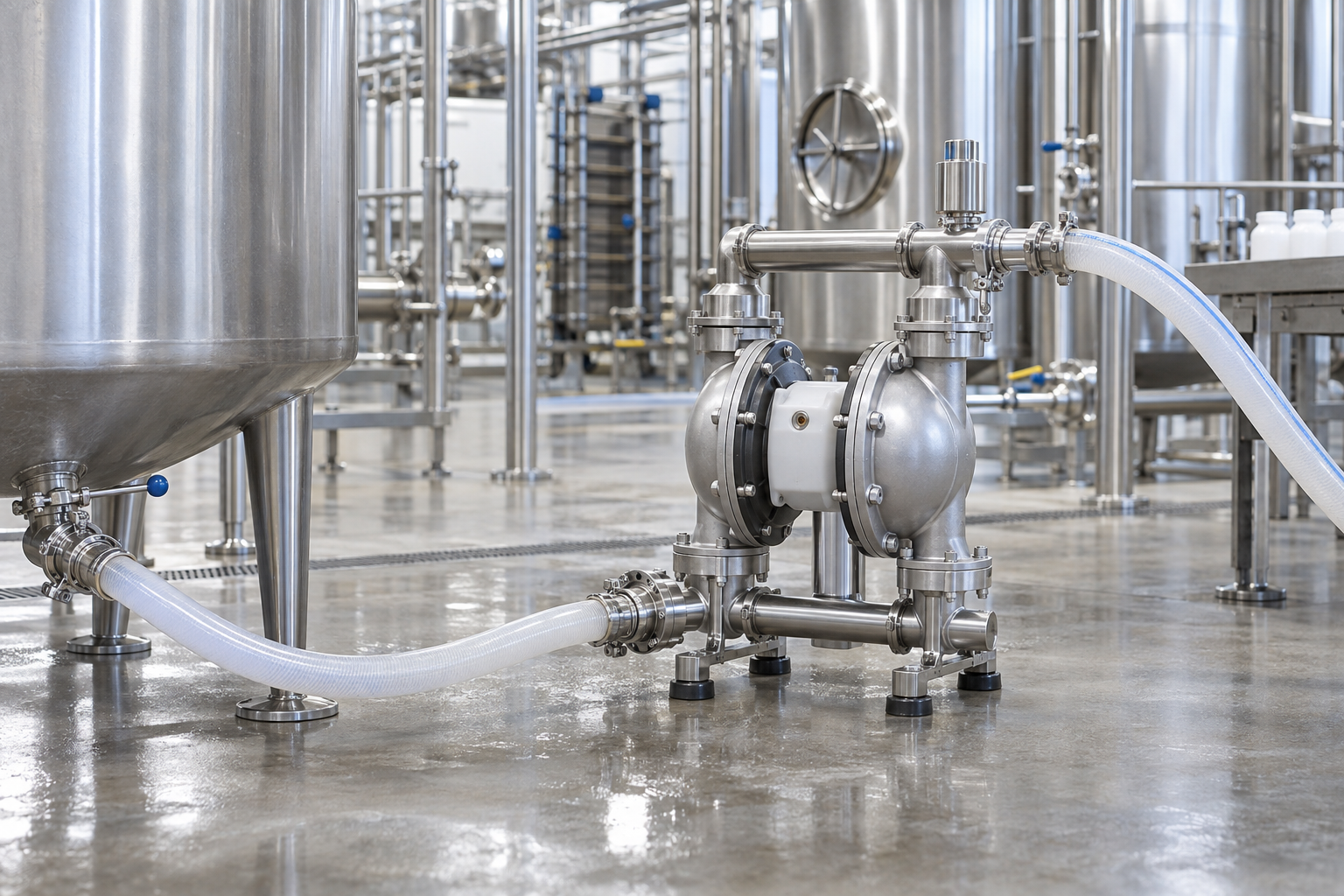
For food and beverage transfer, cleanability is a design requirement rather than an accessory. First establish whether the process requires clean-in-place (CIP), clean-out-of-place (COP) or another validated cleaning procedure. Wilden distinguishes its Saniflo Hygienic Series, which uses a free-draining flow path for CIP capability, from FDA Series pumps intended for standard food applications with quick breakdown and COP cleaning. The required hygiene standard, connection style, cleaning procedure and documentation should be stated before a pump family is selected.
Describe the product at its real process temperature
Send the product name, temperature range and viscosity at the actual transfer temperature. Syrups, sauces, oils, dairy products and concentrates can change viscosity sharply with temperature. Also state whether the product contains soft solids, particulates or inclusions and whether it is shear-sensitive or prone to foaming. Wilden positions its hygienic AODD designs for gentle, low-shear handling, but the exact pump configuration still has to be checked for the product and duty.
Review every wetted component and the cleaning chemistry
Stainless-steel liquid chambers alone do not define a hygienic pump configuration. Review diaphragms, valve elements, seats, seals, manifolds and connection materials together with the process liquid and the cleaning agents. Acid, caustic, sanitizer and hot-water exposure can be more demanding than the product itself. Regulatory or customer requirements should be tied to the exact pump configuration; do not assume that every model in a broad product family carries the same compliance or certification.
Select flow and pressure from the operating point, not the maximum
Required flow must be evaluated together with discharge pressure, suction conditions and available compressed-air pressure and volume. Product viscosity, pipe length, elevation changes, filters, heat exchangers and downstream filling or processing equipment all add resistance. Use the performance data for the exact pump size and diaphragm configuration. If gentle handling is important, include the acceptable transfer rate and process constraints instead of asking only for the highest possible flow.
Common hygienic pump selection mistakes
Common mistakes include choosing a pump because it is stainless steel, treating food-contact compliance and hygienic cleanability as identical concepts, ignoring the cleaning chemicals, sizing from maximum flow alone, or overlooking drainability and maintenance access. Another mistake is selecting a replacement only from the old model without checking whether the process, product, cleaning procedure or required documentation has changed. A complete RFQ should capture both the production duty and the cleaning duty.
Frequently asked questions
What is the difference between a hygienic AODD pump and a standard food-grade AODD pump?
The distinction depends on the exact product family and requirement. Wilden describes its Hygienic Series with a free-draining path for CIP capability, while its FDA Series is intended for standard food applications and clean-out-of-place service. Confirm the required standard and cleaning method before selection.
What data should I send for a viscous food product?
Send the product, viscosity at operating and startup temperatures, temperature range, solids or inclusions, required flow, discharge pressure, suction conditions, cleaning method, connection standard and any hygiene or documentation requirements.
Does stainless steel automatically make a pump suitable for food service?
No. Suitability depends on the complete wetted configuration, surface and cleaning requirements, elastomers or diaphragms, valve components, connections and the specific regulatory or customer requirements for the process.
Can an AODD pump handle shear-sensitive food products?
AODD pumps are commonly used for gentle, low-shear transfer, and Wilden specifically positions its hygienic AODD designs for shear-sensitive products. The exact pump size, cycling rate, valve configuration and process conditions still need to be reviewed for the product.
Related DFIN pages
- Food and beverage applications
- Pharmaceutical and cosmetics applications
- Browse WILDEN complete pumps
- Prepare a hygienic pump RFQ
Technical references
Request hygienic pump selection support
Application guidance only. Confirm the exact pump configuration, required standards, operating point and applicable cleaning procedure before ordering.