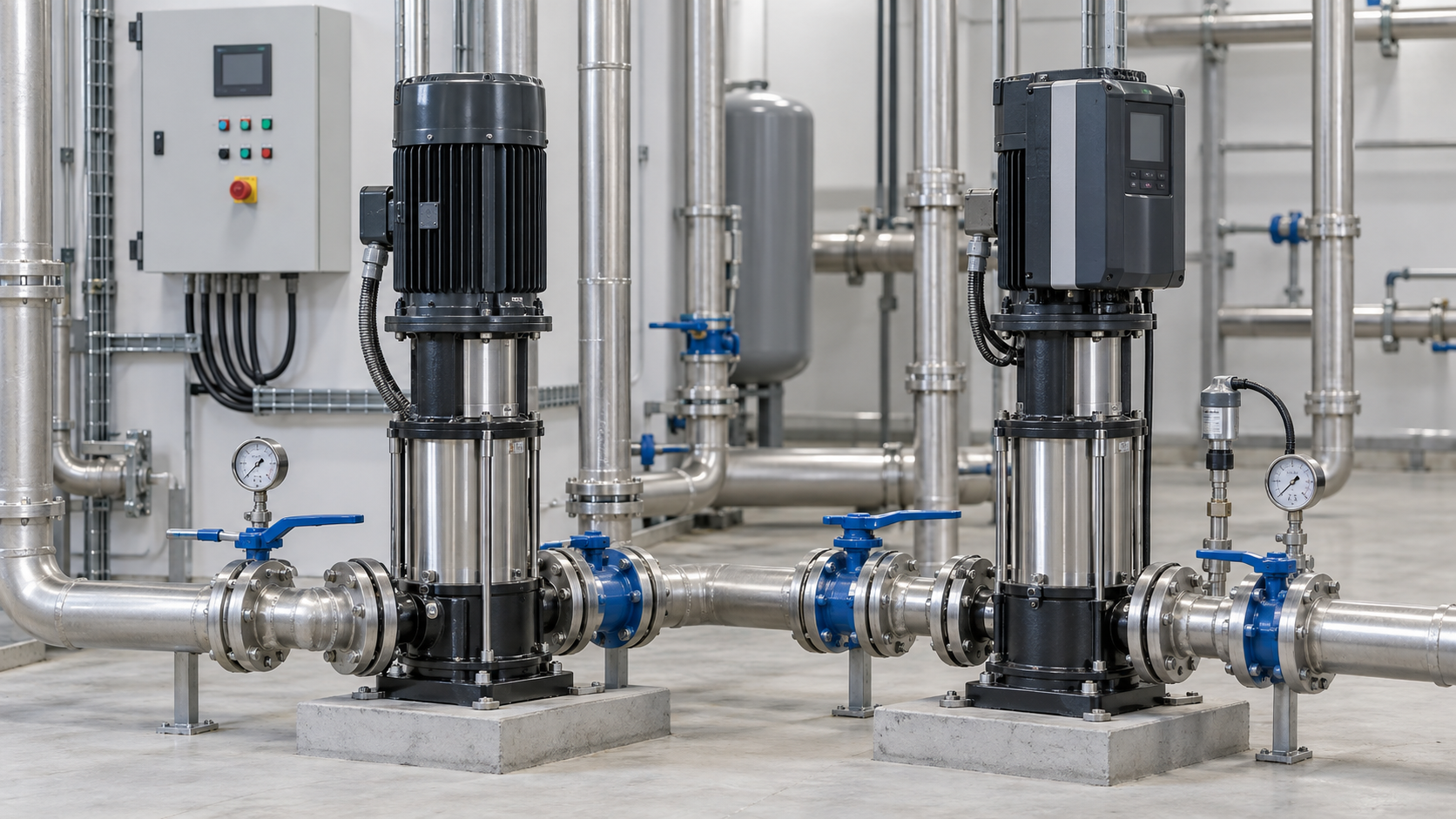
The practical difference between a Grundfos CR and CRE is the motor and control package. A CR is normally selected as a conventional fixed-speed vertical multistage pump, although it can be combined with an external variable-frequency drive. A CRE combines the CR hydraulic platform with a motor that has an integrated variable-frequency drive and electronic control. The better choice depends on the system load profile, control objective, installed electrical architecture and total ownership cost—not simply on which pump has the higher purchase price.
For a steady process duty with an existing control panel, a correctly sized CR can be the simpler choice. For pressure boosting or a process whose demand changes throughout the day, a CRE can reduce throttling and simplify variable-speed control. In both cases, select the exact pump from the required flow, total head, liquid properties, suction conditions, materials, power supply and control requirements.
CR vs CRE in one comparison table
| Decision point | Grundfos CR | Grundfos CRE |
|---|---|---|
| Basic concept | Vertical multistage in-line pump with a conventional motor arrangement | CR hydraulic platform with an integrated variable-speed E-motor and controls |
| Normal speed strategy | Fixed speed unless paired with an external drive | Variable speed is built into the motor package |
| Best fit | Stable duty, simple start/stop control or an existing plant VFD/control panel | Changing demand, constant-pressure control or compact integrated automation |
| Commissioning focus | Motor protection, starter or external VFD, valve setting and system balancing | Sensor signal, setpoint, control mode, limits and communication settings |
| Initial cost pattern | Often lower for a basic fixed-speed package | Often higher because drive and control functions are integrated |
| Lifecycle cost driver | Correct sizing and avoiding continuous throttling or bypass losses | Quality of the load profile, setpoint strategy and commissioning |
This table is a selection guide, not a substitute for the current Grundfos data sheet. Available sizes, motor options, materials, sensors, approvals and communication functions vary by exact product code and market.
Start with the duty point, not the series name
Before comparing CR and CRE, define the operating points the system must actually meet. Provide the normal, minimum and peak flow; total dynamic head; inlet pressure; liquid temperature and density; operating hours; and the expected demand pattern. A pump selected only from the maximum design flow may run far from its preferred operating region during most of the year.
Total head must include static elevation, pressure required at the destination and losses through pipe, fittings, valves, filters, heat exchangers and other equipment. If the receiving vessel is pressurized, include that pressure. If suction pressure varies, check the least favorable operating condition and confirm available NPSH against the exact pump curve.
Choose CR when the process duty is stable
A CR is often appropriate when flow and head stay close to one operating point and the plant already has a suitable starter, protection system or external VFD. This keeps the pump package straightforward and may align with a facility's standard motor and control practices.
Fixed speed does not remove the need for careful sizing. A pump that produces much more head than the system needs may require continuous throttling, which wastes energy and can move operation away from the intended duty. Avoid solving uncertainty by adding excessive stages or motor power without checking the system curve.
Choose CRE when demand changes or pressure must be controlled
A CRE is designed for variable-speed operation with the drive integrated into the motor. It is especially useful when demand changes and the pump must maintain a pressure, flow or other controlled value based on a compatible sensor and control mode.
Typical candidates include pressure boosting, wash systems with changing users, process supply with variable consumption, cooling or circulation duties with changing loads, and installations where compact integrated control is preferable to a separate drive cabinet. The control objective must still be defined correctly; an integrated drive cannot compensate for a poor hydraulic selection or an unsuitable sensor location.
Does CRE always save energy?
No. Variable speed creates an opportunity to reduce energy use when the system spends meaningful time below peak demand, particularly in systems where pressure loss changes with flow. The actual saving depends on the load profile, static-head share, required minimum pressure, pump efficiency across the operating range, motor and drive losses, and the chosen control strategy.
If the pump runs almost continuously at one duty point, a well-selected fixed-speed CR may be equally rational. If demand varies but a fixed-speed pump is controlled by throttling or bypassing, a CRE may reduce avoidable losses. Compare annual energy at several representative load points rather than relying on one full-load efficiency value or a universal savings percentage.
CR with an external VFD vs CRE with an integrated drive
A CR connected to a properly engineered external VFD can also provide variable-speed operation. The decision then becomes one of control architecture and lifecycle support.
- Choose CR plus an external VFD when the facility standardizes drives in a central panel, requires a particular drive brand, needs long motor cables or wants controls separated from heat, washdown or other site conditions.
- Choose CRE when an integrated package can reduce panel space, wiring and coordination between separate motor, drive and controller components.
- Review maintenance strategy because the preferred spare-parts plan, technician skills and replacement procedure may differ between an external drive system and an integrated E-motor.
Compare control requirements before ordering
Write a short control description before selecting the pump. State what variable is controlled, where it is measured, the required setpoint range, minimum and maximum speed, start/stop logic, alarm handling, backup mode and any building-management or process-control communication.
For constant-pressure service, sensor position matters. A sensor close to the pump measures a different system condition from a sensor near the most critical user. Confirm signal type, power supply, communication protocol and responsibility for commissioning. Do not assume that every CRE product code includes the same sensor or factory configuration.
Check liquid and material compatibility
CR, CRI, CRN and related E-pump variants use different material combinations. The presence or absence of the letter “E” describes the motor and control concept; it does not by itself define wetted materials or chemical compatibility.
Provide the complete liquid composition, concentration, temperature, pH where relevant, cleaning chemicals, solids and any risk of crystallization. Check pump head and base materials, hydraulic components, shaft seal faces and elastomers as a complete wetted path. For hot, aggressive, hazardous or high-pressure service, request a configuration-specific review and current manufacturer documentation.
Verify suction conditions and NPSH
CR and CRE pumps are non-self-priming vertical multistage centrifugal pumps. The suction line must remain filled and provide adequate pressure at every operating point. Review liquid level, inlet pressure, pipe diameter, strainers, valves, temperature and vapor pressure.
Variable speed changes both the pump duty and the NPSH requirement, but it does not make an inadequate suction design acceptable. Protect the pump against dry running and air entry using controls suitable for the installation.
Motor, power supply and installation checks
Confirm voltage, phase, frequency, available short-circuit protection, enclosure needs, ambient temperature, altitude and local electrical rules. For a CR, define the starter or external VFD and motor-protection arrangement. For a CRE, confirm the exact E-motor supply and the electrical compatibility of sensors, digital inputs, relays and communications.
Both series use an in-line vertical layout that can save floor space, but the pipework must not place unacceptable loads on the pump. Check foundation, access above the pump, ventilation around the motor, isolation valves, pressure gauges, drainage and space for seal or motor service.
When does a CR-to-CRE retrofit make sense?
A retrofit can be attractive when the existing fixed-speed pump is throttled for long periods, system demand varies widely, pressure complaints occur at low or high demand, or the control panel is due for renewal. First record actual flow, suction and discharge pressure, motor current and operating hours across a representative period.
Do not assume that a CRE with a similar name is a drop-in replacement. Verify dimensions, flange standard, hydraulic curve, stage count, motor power, supply voltage, sensor arrangement, setpoint logic, minimum flow and communication. The lowest-risk retrofit is based on measured system data and a documented commissioning plan.
How CR and CRE pricing should be compared
Price depends on flow size, stage count, motor power, material variant, shaft seal, connection, voltage, sensor package, approvals, communication options, quantity and destination. A CRE normally includes functions that may otherwise require an external VFD, controller, sensor interface, protection and additional panel work, so comparing pump-only prices can be misleading.
Compare the complete installed scope and expected lifecycle cost: pump, motor, drive, panel, sensors, wiring, commissioning, annual energy, planned maintenance, critical spares and downtime exposure. DFIN does not recommend using a generic online price as a final budget for a configured industrial pump.
A practical selection workflow
- Define normal, minimum and peak flow with total head at each point.
- Describe the load profile and the variable that must be controlled.
- Check liquid properties, wetted materials, shaft seal and temperature.
- Review suction pressure, NPSH margin and dry-run protection.
- Compare a fixed-speed CR, CR with external VFD and CRE at the same duties.
- Confirm electrical supply, sensor, communication and commissioning scope.
- Compare installed and lifecycle cost, then verify the complete product code.
RFQ checklist for faster selection and quotation
Send the required flow range and total head, liquid name and concentration, temperature, density, viscosity, inlet pressure, operating hours, demand profile, preferred control mode, sensor details, voltage and frequency, connection standard, material or seal requirements, compliance needs, quantity and delivery destination.
For a replacement, also provide the full existing model, product number, serial number, nameplate photo, pump and pipework photos, current operating readings and the reason for replacement. Use DFIN's pump RFQ form or browse the Grundfos product references before sending the enquiry.
Frequently asked questions
What is the main difference between Grundfos CR and CRE?
The principal difference is the motor and control arrangement. CRE uses an integrated variable-speed E-motor and electronic controls, while CR is normally supplied with a conventional motor and can use fixed speed or a separately engineered external drive.
Can a standard CR pump use a VFD?
Often yes, if the exact motor and pump configuration are suitable and the drive, protection, speed limits and installation are engineered correctly. Confirm the current motor and pump documentation rather than assuming compatibility.
Is CRE always the more efficient choice?
No. CRE can reduce energy use in a variable-demand system, but the result depends on the load profile and control strategy. For a stable duty, a correctly sized CR may be the better-value solution.
Can I replace a CR with a CRE without changing the pipework?
Possibly, but not from the family name alone. Check flange dimensions, hydraulic curve, stage count, motor and control dimensions, electrical supply, sensor arrangement and commissioning requirements.
What information is needed for an accurate price?
Provide the full duty, liquid data, material and seal requirements, electrical supply, control functions, connection, approvals, quantity and destination. For replacements, include the complete product code and nameplate.
Related DFIN resources
- Browse Grundfos pump and spare-part references
- Industrial pump applications
- Contact DFIN Pump
- Request pump selection and quotation support
Technical references
- Grundfos CR/CRE vertical multistage variable-speed system literature
- Grundfos CR, CRI, CRN, CRE, CRIE and CRNE data booklet
- Grundfos CR product overview and service information
Application guidance only. Confirm the current performance curve, material compatibility, shaft seal, motor, electrical data, control functions, approvals and installation instructions for the exact Grundfos product code before ordering or commissioning.