Define the wastewater duty before choosing a pump
Start with the liquid and the solids, not the connection size. Record the fluid composition, temperature and viscosity, then describe the solids by maximum particle size, approximate concentration, shape and whether they are soft, fibrous, abrasive or prone to settling. Add the required flow, discharge pressure, suction lift or flooded-suction condition, hose or pipe length, elevation changes and whether the pump will run continuously, intermittently or submerged. These details determine whether a general-purpose AODD configuration is appropriate or whether a solids-handling design should be reviewed.
Match the solids path, check valves and internal clearance
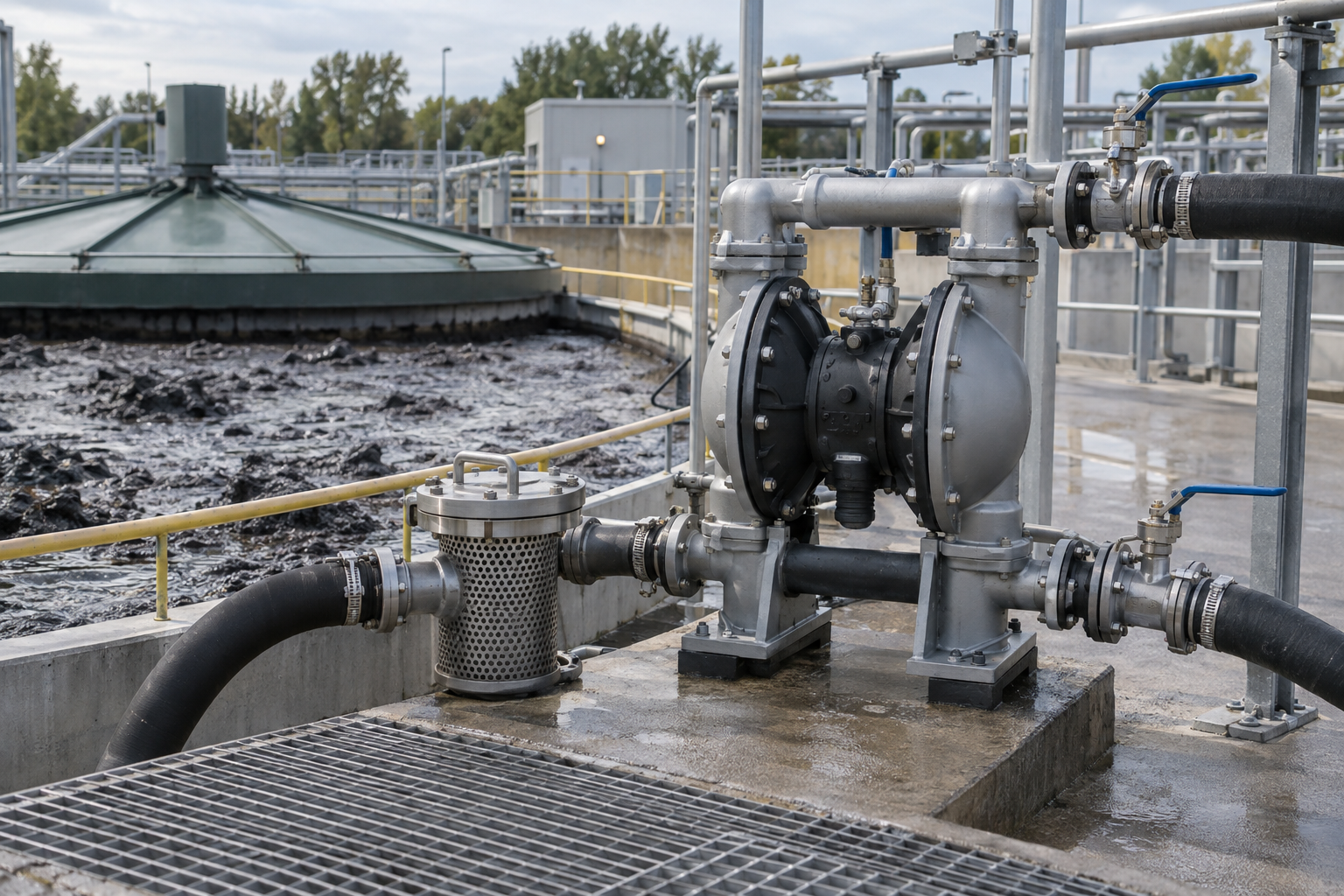
Wastewater can contain grit, sludge, fibers and compressible solids that behave very differently inside a pump. Wilden identifies AODD pumps as suitable for many water and wastewater duties and offers specialty solids-handling designs with larger internal clearances and flow-through paths. Wilden publishes a maximum solids diameter of 76 mm (3 in.) for the T1510 Brahma model; other pump sizes and configurations have different limits, so this number must not be treated as a general AODD rating. The selected pump must be checked against the actual particle size and character, including the valve style and internal passage geometry.
Review suction conditions and compressed-air supply together
Self-priming capability does not remove suction losses. Long suction hoses, undersized lines, excessive lift, clogged strainers and air leaks can prevent the liquid chambers from filling completely. At the same time, an AODD pump needs enough air pressure and air volume at the operating point. For submerged service, Wilden advises that the exhaust must be arranged to prevent liquid from entering through the exhaust. AODD pumps can run dry, but unnecessary high-speed dry cycling can increase diaphragm wear, so dry running should not be treated as the normal control strategy.
Check abrasion and chemical compatibility across all wetted parts
Wastewater service can combine abrasive solids with treatment chemicals, oils, cleaning agents or variable pH. Review the complete wetted construction: liquid chambers, manifolds, diaphragms, valve balls or flaps, valve seats and seals. A body material that tolerates the liquid does not automatically make the complete configuration suitable. If the service includes intermittent settling, also consider whether retained solids could obstruct check valves or harden inside the pump between cycles.
Common wastewater pump selection mistakes
Common mistakes include selecting only by nominal port size, using the largest stated solids passage as the design target, ignoring suction-line losses, assuming every wastewater stream has the same abrasiveness, or copying materials from a previous pump without reviewing why that pump failed. Another mistake is overlooking the air system. A pump that is hydraulically suitable can still deliver poor flow if the regulator, filter, hose, valves or compressor restrict the required air volume. For replacement work, send the existing pump model and item number together with the actual operating problem.
Frequently asked questions
What information should I send for an AODD wastewater pump selection?
Send the fluid description, solids size and concentration, viscosity, temperature, required flow, discharge pressure, suction lift or tank arrangement, line size and length, air supply, duty cycle and whether the pump will be submerged.
Can every AODD pump handle large solids?
No. Solids capability depends on the exact pump size, check-valve design and internal passage. Use the model-specific solids limit and leave practical margin rather than assuming all AODD pumps have the same capability.
Can an AODD pump run submerged in wastewater?
Certain Wilden AODD configurations are used in submerged service, but material compatibility and exhaust routing must be checked. The exhaust must be protected from liquid entry, and the exact installation should follow the applicable manufacturer instructions.
Should I use a strainer on the suction side?
It depends on the solids the pump is intended to pass. A strainer can protect the pump from oversized debris, but if it is too fine or becomes clogged it can create excessive suction loss. Size and maintenance of the strainer must be considered as part of the suction system.
Related DFIN pages
- Water and wastewater applications
- Browse WILDEN complete pumps
- WILDEN repair kits and spare parts
- Prepare a wastewater pump RFQ
Technical references
Request wastewater pump selection support
Application guidance only. Confirm the exact pump configuration, operating point and manufacturer instructions before ordering or maintenance.